Captured 2 August 2026
Same prompt, real output
Feature tables are claims. This page is evidence: three real prompts, each pasted verbatim into Skiaw and into Gamma or ChatGPT on the same day, one attempt per tool, no retries and no edits. The screenshots are what came back — including where the other tool did better.
Test 1 · Captured 2 August 2026
A pre-seed pitch deck, vs Gamma
A founder brief with real numbers and a specific audience — the kind of deck where an invented figure gets you caught in the room.
pitch deck for Notely, an AI note-taking app for university students. We transcribe lectures and turn them into flashcards. 12k users, €8/month, 4% conversion from free. Raising a €500k pre-seed to hire 2 engineers and push into Germany. Audience: French early-stage VCs.
Gamma
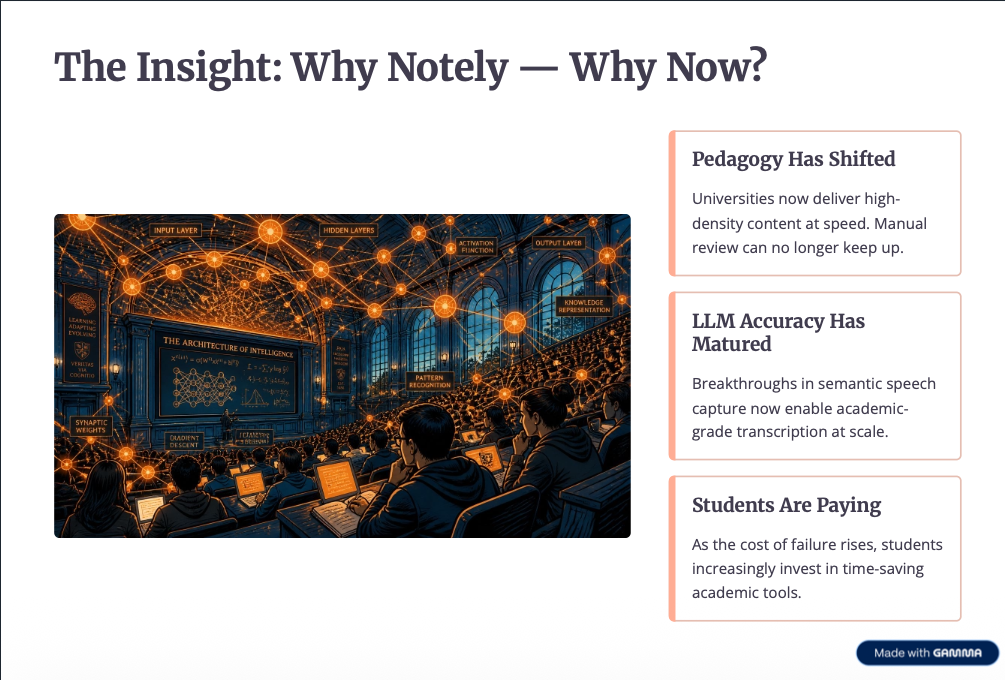
- Generated noticeably faster than Skiaw did.
- Spent 330 credits on this deck; a Plus plan carries 1,000 a month.
- Illustrates the slide with an AI-generated image rather than the deck's data.
- Claims like “LLM accuracy has matured” carry no source a VC could check.
- Exports carry the Made with Gamma watermark below the paid tiers.
Skiaw
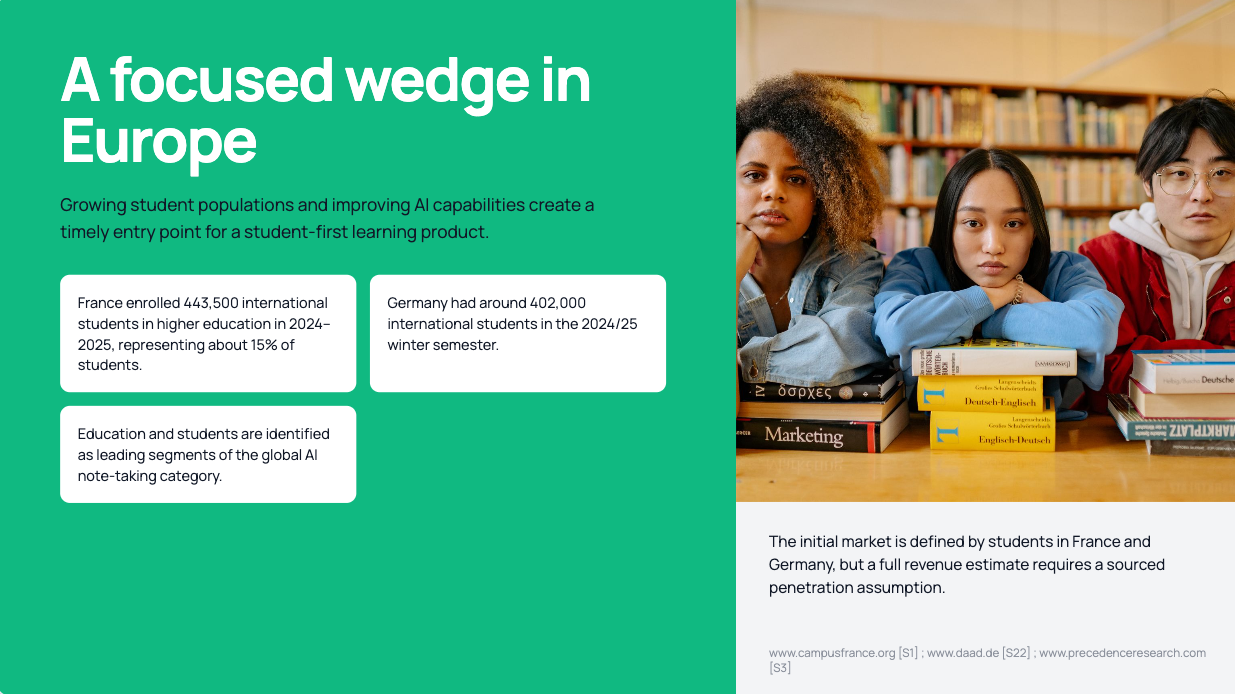
- Spent 20 credits on the full deck.
- Market figures are on-slide and cited: campusfrance.org, daad.de, precedenceresearch.com.
- States its own limits — the slide says a revenue estimate still needs a sourced penetration assumption rather than inventing one.
- No watermark on any plan, including the $1 trial.
Gamma's slide is finished sooner and more decorated; Skiaw's is the one whose numbers survive a VC asking “where is that from?”.
Test 2 · Captured 2 August 2026
A training workshop, vs Gamma
A structural brief: a fixed slide count and exercises between sections. The test is whether the tool follows the spec, not whether it can write about time management.
workshop deck on time management for a team of 15 junior consultants. Cover the Eisenhower matrix, time blocking, and saying no to meetings. Half-day session, needs exercises between sections. 12 slides.
Gamma
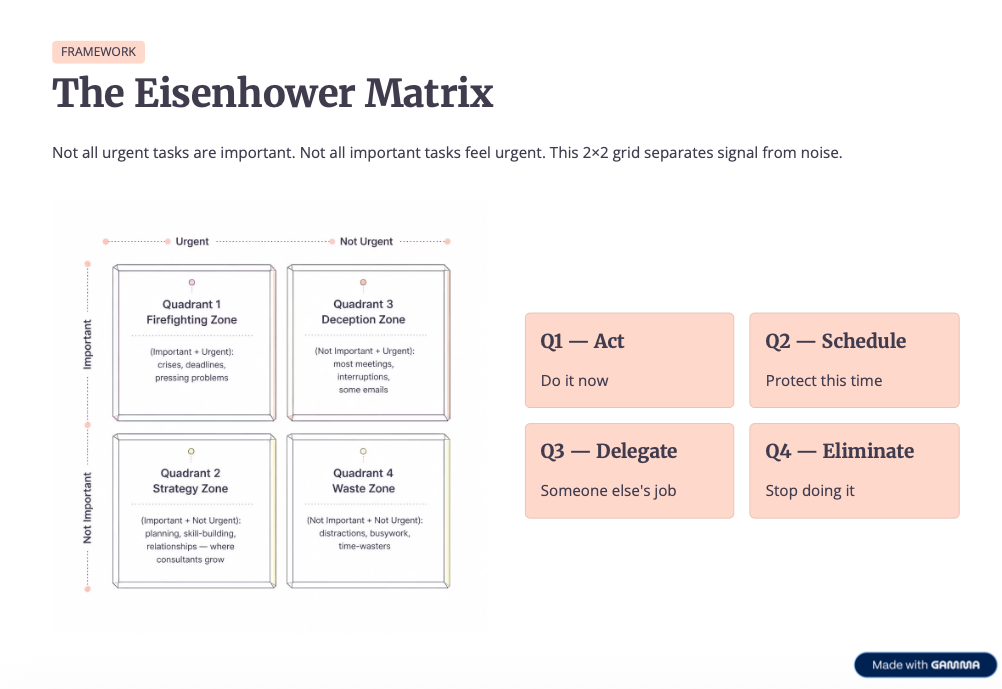
- Generated faster, and the Eisenhower diagram is a genuinely clear visual.
- Spent 260 credits on this deck.
- Delivered 10 slides against the 12 the brief asked for.
- Exports carry the Made with Gamma watermark below the paid tiers.
Skiaw
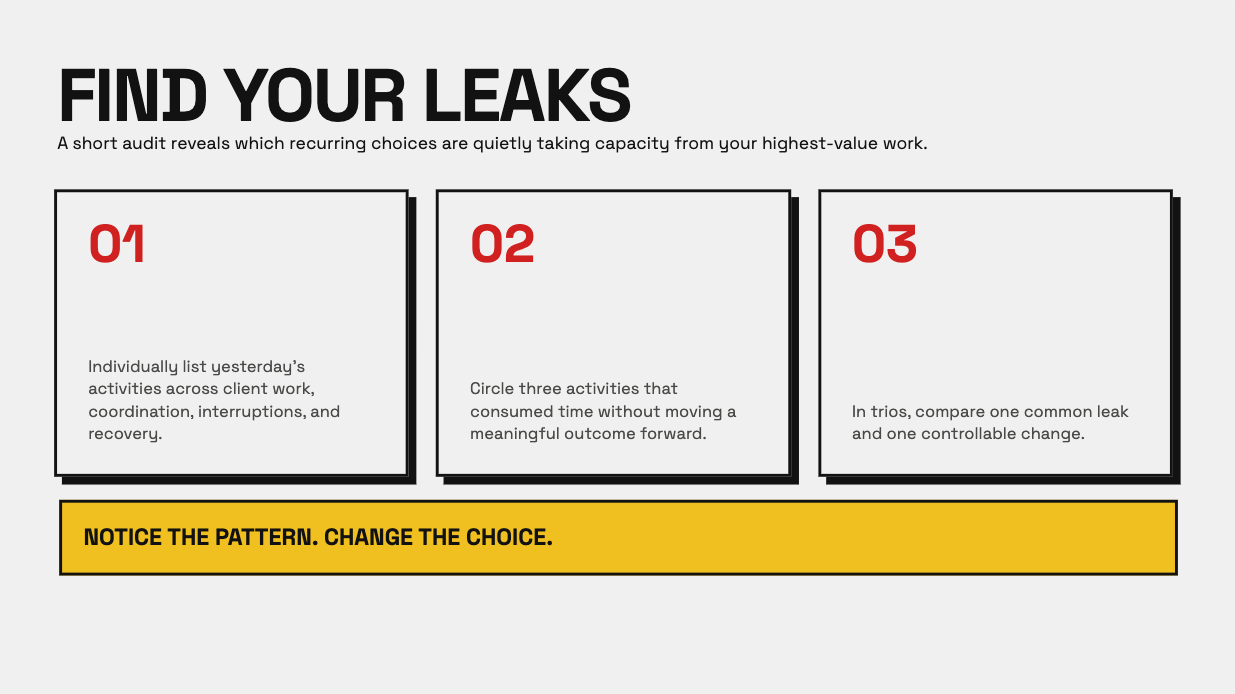
- Spent 20 credits on the full deck.
- Delivered the 12 slides the brief specified.
- The exercises the brief asked for exist as real slides — this one is a facilitated audit, not a bullet list about exercises.
- Theme is a designed system (Editorial Brutalism here), so the deck does not read as a default template.
Both understood the topic. One followed the spec: 12 slides with exercises versus 10 slides for 13× the credits.
Test 3 · Captured 2 August 2026
A season review, vs ChatGPT
An everyday deck with a delicate tone: honest about a weakness, encouraging to a room of parents. ChatGPT is a general assistant, so this is a test of what “it can make slides too” means in practice.
season review for the U15 football team I coach. Finished 4th of 12, best defense in the league but scored the fewest goals of the top six. Presenting to parents. Needs to be encouraging while being honest about the finishing problem.
ChatGPT
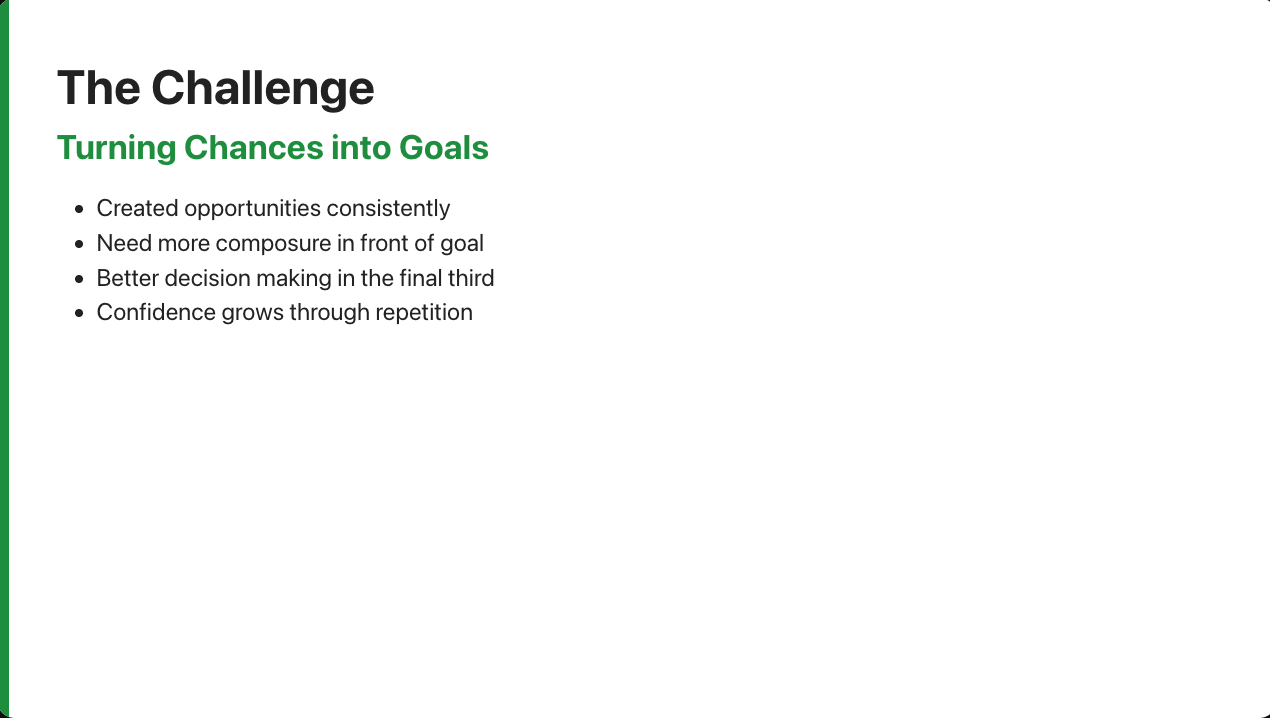
- The content judgement is sound — it read the brief and framed the finishing problem constructively.
- Produced from a plan already included in a ChatGPT subscription, with no separate deck tool to buy.
- The slide itself is unstyled: default bullets, no layout, two-thirds of the canvas empty.
- No sources; ChatGPT is not purpose-built for decks, and the file shows it.
Skiaw
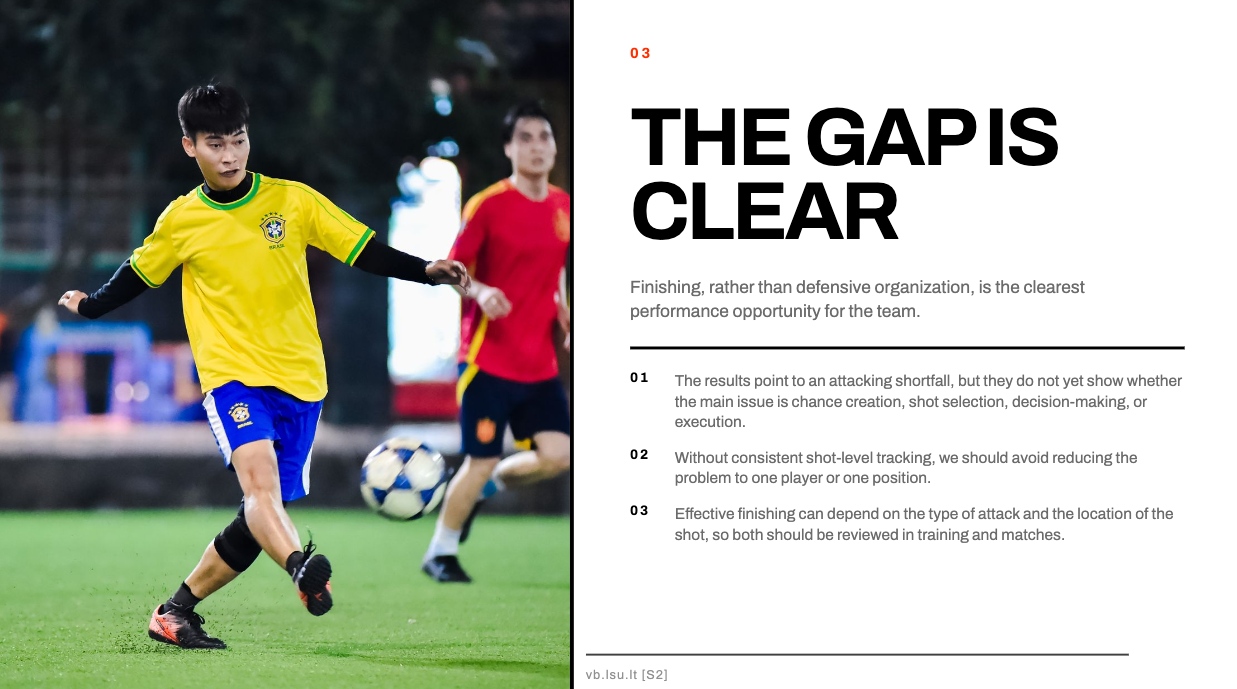
- A designed slide: full-bleed photograph, typographic hierarchy, numbered analysis.
- Careful with the data — it flags that without shot-level tracking the problem should not be pinned on one player.
- The league statistic carries a source footnote on the slide.
- Costs a subscription where ChatGPT may already be free for you — that trade is real.
ChatGPT writes a good outline and a plain file. If the deck is going in front of a room, the design gap is the whole difference.
What we make of it
Three prompts is a sample, not a study. But the pattern was consistent enough to say plainly who each tool is for.
Pick Gamma when
- Speed matters most: in both runs it returned a finished deck sooner.
- You want AI illustrations and a decorated look out of the box.
- You also need docs, websites and hosted sharing from the same tool.
Pick ChatGPT when
- You already pay for it and the deck is internal — the outline quality is real.
- You want the thinking more than the file, and will style slides yourself.
- Budget is zero: a plain deck for free is sometimes the right trade.
Pick Skiaw when
- The numbers on the slide must carry a source someone can check in the room.
- The brief is a spec — slide counts and structure are followed, not approximated.
- You care what a deck costs: these ran at 20 credits against 260–330.
- The file goes in front of clients and cannot carry another product's watermark.
Frequently asked questions
How these tests were run, and how to run them yourself.
How were these comparisons run?
Each prompt was written once, pasted verbatim into both tools on the same day, and each tool got one attempt — no retries, no regeneration, no manual edits. The screenshots are unedited captures of one representative slide from each result, taken on 2 August 2026.
Did you pick the worst competitor slides on purpose?
No. From each deck we picked the slide covering the same part of the brief in both tools, so like is compared with like. Where the other tool did something well — Gamma's speed and its Eisenhower diagram, ChatGPT's framing of the finishing problem — the page says so.
Why do the Gamma decks cost 260–330 credits and the Skiaw decks 20?
Gamma meters generation, AI images and AI edits against a credit balance; these two decks drew 330 and 260 credits from a Plus plan's 1,000 per month. Skiaw's best-quality generation costs 20 credits per deck, and conversational edits cost nothing.
Is Gamma faster than Skiaw?
In these runs, yes — Gamma returned its deck noticeably sooner. Skiaw spends the extra time on research, source citations and layout verification before you see the deck. If raw speed matters more to you than sourcing, that is a genuine reason to pick Gamma.
Can I reproduce these results?
Yes — the prompts are printed in full above, so you can paste them into Gamma, ChatGPT and Skiaw yourself. Generation is non-deterministic, so your slides will differ in detail, but the pattern these pages describe — credit cost, sourcing, slide-count fidelity, watermarks — is what to check for.
Go deeper
The screenshots show one slide each. The full comparisons cover everything the screenshots cannot.
Skiaw vs Gamma, in full
The complete comparison behind tests 1 and 2: exports, credits, citations and pricing, every claim sourced and dated.
Skiaw vs ChatGPT, in full
What “ChatGPT can make slides” actually covers, compared feature by feature against a purpose-built deck engine.
All comparisons
Gamma, Beautiful.ai, GenPPT and ChatGPT, each compared the same honest way.
The prompts are printed above — the fairest test is your own brief.